
Elementary PE Games With Simple Rules and Fair Teams
A ready-to-use PE games collection with rules, equipment, grade ranges, and team-splitting tips for every game. Includes tag, relay, cooperative, warm-up, and indoor rainy-day options.
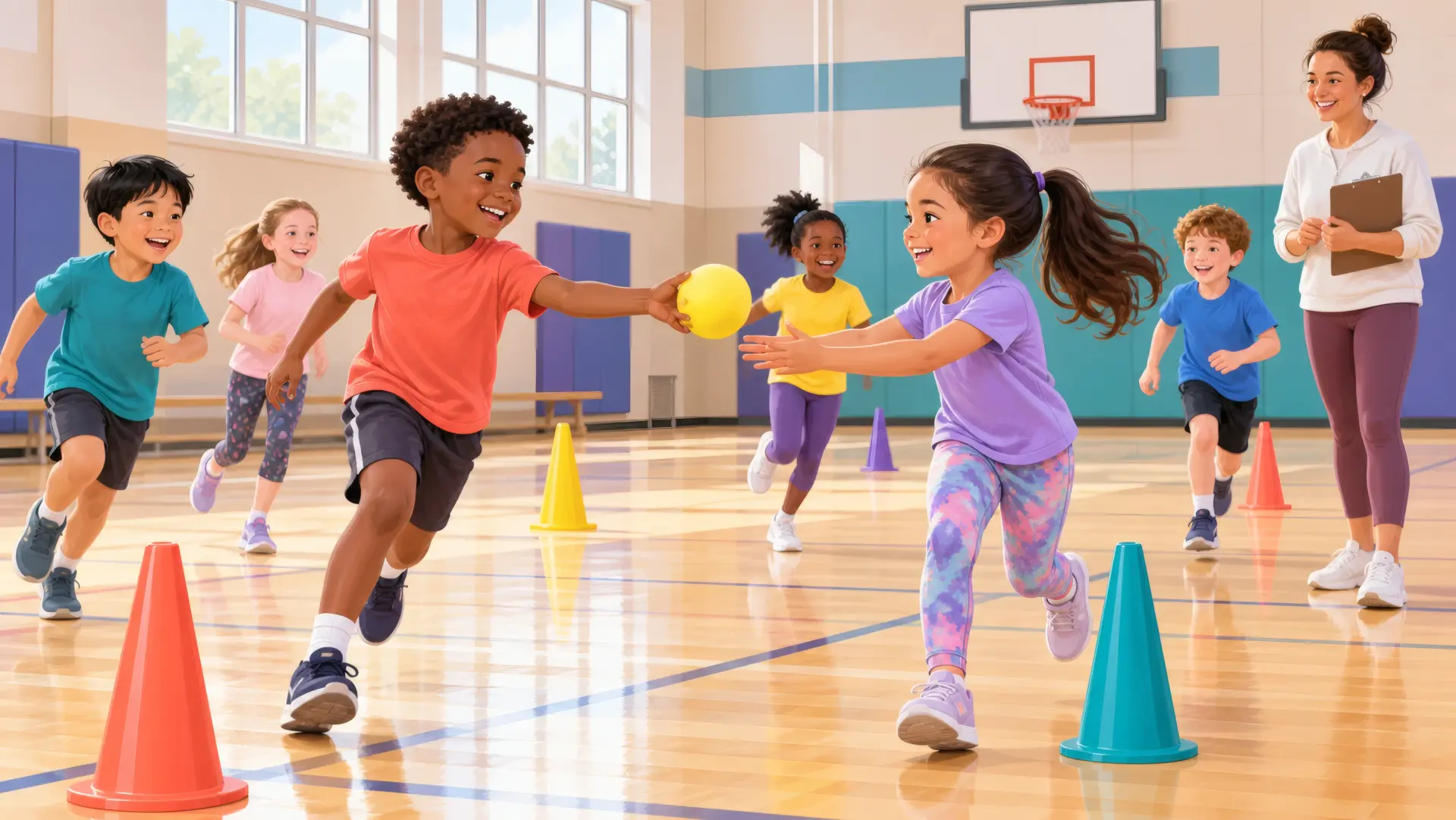
The gym floor is already loud before the first elementary PE game begins. You need rules that fit in a breath, equipment you can find, and enough movement that nobody spends ten minutes waiting in line.
I taught elementary PE for six years. The games below survived contact with a gym full of second-graders. The fancy activities from the conference handbook often fell apart by round two; these held up.
Featured tool
Random Team Generator
Paste your class list, pick 2 to 6 teams, and tap Shuffle. Copy the result onto your clipboard before students arrive. Works for every game below.
Quick-reference table
Pick a game, check what you need, and go.
| Game | Type | Grades | Equipment | Setup time |
|---|---|---|---|---|
| Freeze Tag | Tag | K–5 | None | 1 min |
| Sharks and Minnows | Tag | K–5 | Cones | 2 min |
| Blob Tag | Tag | 2–5 | None | 1 min |
| Line Tag | Tag | K–5 | Gym lines | 0 min |
| Relay Races (classic) | Relay | K–5 | Cones | 3 min |
| Over-Under Relay | Relay | 1–5 | Balls | 3 min |
| Scooter Relay | Relay | 2–5 | Scooters, cones | 5 min |
| Hula Hoop Pass | Cooperative | K–5 | Hula hoops | 1 min |
| Parachute Popcorn | Cooperative | K–3 | Parachute, foam balls | 2 min |
| Human Knot | Cooperative | 3–5 | None | 1 min |
| Bridge Builders | Cooperative | 2–5 | Pool noodles, cones | 3 min |
| Animal Walks | Warm-up | K–2 | None | 0 min |
| Red Light, Green Light | Warm-up | K–3 | None | 1 min |
| Simon Says Fitness | Warm-up | K–5 | None | 0 min |
| Musical Statues | Warm-up | K–3 | Speaker | 1 min |
| Capture the Flag | Main | 3–5 | Flags/pinnies, cones | 5 min |
| Kickball (modified) | Main | 2–5 | Kickball, bases | 3 min |
| Dodgeball (foam) | Main | 3–5 | Foam balls | 2 min |
| Bowling Pins | Main | K–5 | Bowling pins, foam balls | 3 min |
| Four Corners | Indoor | K–5 | Corner signs | 1 min |
| Heads Up, Seven Up | Indoor | K–5 | None | 1 min |
| Yoga Freeze | Indoor | K–3 | Yoga cards | 1 min |
| Paper Plate Skating | Indoor | K–5 | Paper plates | 1 min |
| Balloon Volleyball | Indoor | 1–5 | Balloons, string/tape | 3 min |
| Fitness Bingo | Warm-up | K–5 | Bingo cards, exercise list | 5 min |
For classroom grouping methods beyond PE — playing cards, birthday lineups, and more — see fun ways to divide students into groups.
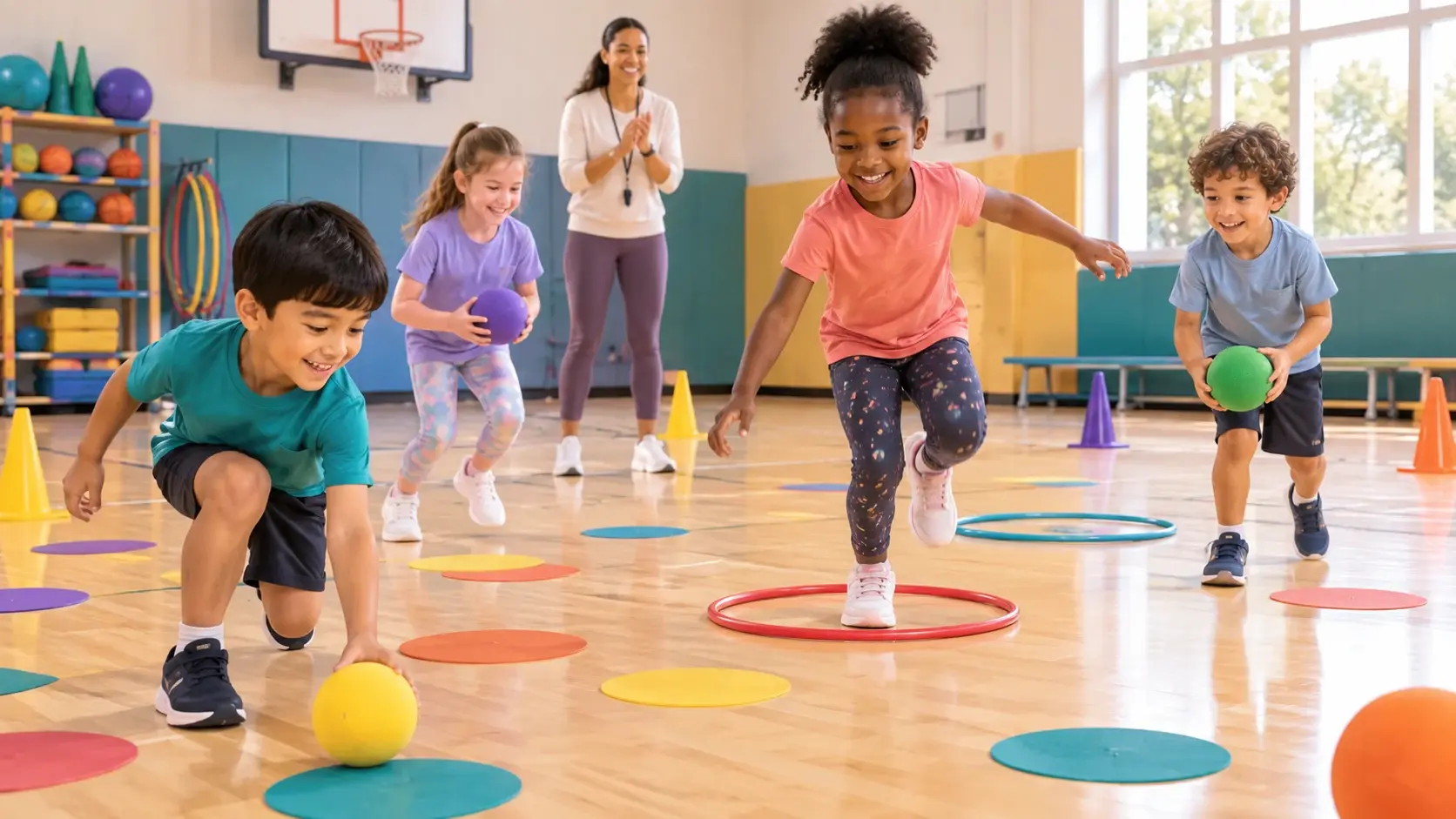
Tag games
Tag games are the fastest way to get a class moving. They need almost no equipment and the rules fit in one sentence.
1. Freeze Tag
Grades K–5 | No equipment | 1 minute setup
Two or three taggers (depending on class size) chase the rest. Tagged players freeze in place. A free player can unfreeze someone by crawling through their legs, giving a high five, or whatever signal you pick.
Rules:
- Choose 2–3 taggers. Give them pinnies or colored bands if available.
- Everyone else spreads out inside the boundaries.
- Taggers chase and tag with a gentle touch on the shoulder or back.
- A tagged player freezes immediately — feet planted, arms out.
- A free player unfreezes someone by crawling between their legs (or a high five for smaller kids).
- Round ends after 2–3 minutes. Rotate taggers.
Variation: "Everybody's It" — everyone is a tagger. If two players tag each other simultaneously, both freeze. Last person standing wins. This version is chaos in the best way and eliminates the problem of one shy student hiding from a single tagger.
Adaptation: A student who cannot run can be a "medic" who unfreezes players from a stationary spot by waving a foam noodle.
2. Sharks and Minnows
Grades K–5 | Cones for boundaries | 2 minutes setup
One to three sharks stand in the middle of the gym. Minnows line up on one end. On "Go," minnows run to the other end without getting tagged. Tagged minnows become seaweed — they stay put and can tag passing minnows with outstretched arms (feet stay planted).
I used this on the first day of school every year. It teaches boundaries, honesty about being tagged, and it burns off nerves fast.
Rules:
- Mark two safe zones with cones at opposite ends.
- Sharks start in the center.
- On "Swim!", minnows run from one safe zone to the other.
- A tagged minnow becomes seaweed where they were tagged.
- Seaweed can tag with arms only — no moving feet.
- Last minnow standing becomes a shark next round.
Variation: "Octopus Tag" — same setup, but tagged players sit down and can tag others within arm's reach. Keeps the game moving faster for younger groups.
3. Blob Tag
Grades 2–5 | No equipment | 1 minute setup
One tagger starts. When they tag someone, the two join hands and chase together. The blob grows with each tag. Only the players on the ends of the chain can tag. When the blob reaches six players, it splits into two groups of three.
This game teaches cooperation more than any "teamwork" lecture I ever gave. A blob that doesn't communicate runs into itself.
Rules:
- One student starts as the blob.
- Tag someone — they join hands with you.
- Only the two end players can tag.
- At six players, the blob splits into two groups of three.
- Last free player becomes the starting blob next round.
Adaptation: Allow walking speed for the blob if coordination is a challenge. It is still surprisingly effective.
4. Line Tag
Grades K–5 | Gym floor lines | 0 minutes setup
Players can only move along the painted lines on the gym floor. One tagger chases. If a player steps off the line, they freeze for five seconds. This game turns an ordinary gym floor into a maze.
Rules:
- Choose 1–2 taggers.
- All players move only on the painted lines.
- No jumping between lines — you must walk or jog along connected lines.
- Step off a line and you freeze for 5 seconds.
- Tagged players sit at the nearest intersection and become "roadblocks" — other players must go around.
Variation: Two taggers start at opposite corners. Where they meet is anyone's problem.
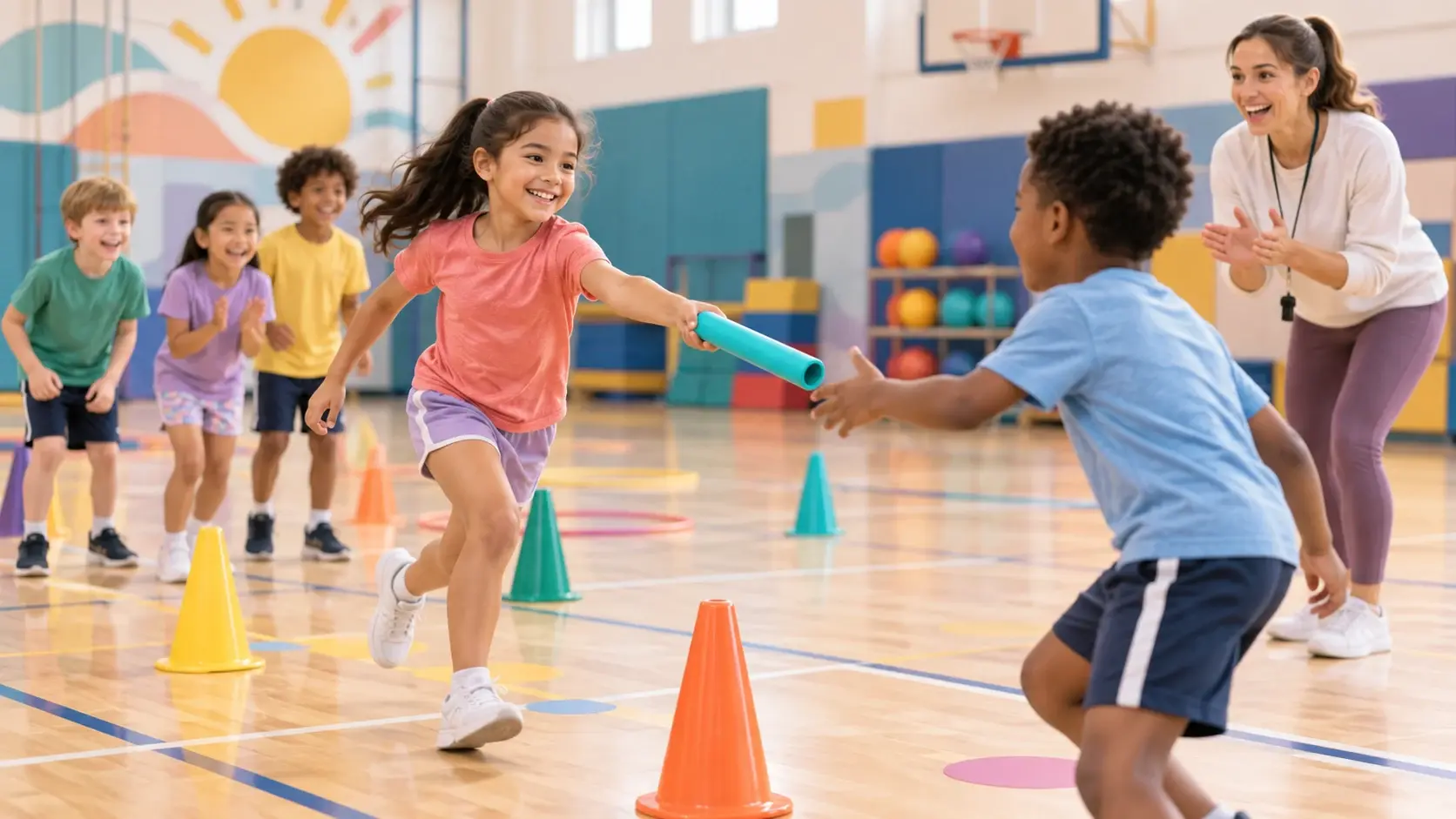
Relay races
Relays keep wait times short when teams stay small. Four to six students per team works well. Add more and the line becomes a standing lesson in boredom.
5. Classic Relay Race
Grades K–5 | Cones | 3 minutes setup
Teams line up behind a starting cone. First player runs to the far cone, touches it, runs back, and tags the next player. First team to finish wins.
Rules:
- Split into teams of 4–6. Use the Random Team Generator or count off.
- Place a turnaround cone 15–25 meters away per team.
- First runner goes on "Go!" — sprint to the cone, touch it, sprint back.
- High-five or hand-off to the next runner.
- Team sits down when finished.
Variations:
- Crab walk relay — hands and feet on the ground, belly up.
- Bear crawl relay — hands and feet, belly down.
- Skip relay — skipping only, no running.
- Backwards relay — jogging backward. Place a spotter at the turnaround.
6. Over-Under Relay
Grades 1–5 | One ball per team | 3 minutes setup
Teams line up single file. The first player passes the ball overhead to the next player. That player passes it between their legs to the person behind them. Alternate over and under until the ball reaches the end. Last player runs to the front and starts again. First team to cycle through everyone wins.
My third-graders called this the "spaghetti relay" and I never found out why, but the name stuck for three years.
Rules:
- Teams of 5–6 in a line, arm's length apart.
- First player passes the ball overhead.
- Next player passes between legs.
- Alternate until the ball reaches the last player.
- Last player runs to the front and starts the pattern again.
- First team to return the original leader to the front wins.
7. Scooter Relay
Grades 2–5 | Scooters and cones | 5 minutes setup
Players sit on a scooter board and use their hands to propel themselves to the far cone and back. The scooter stays under the student's bottom — no standing, no kneeling, no lying on stomachs (this matters for safety; fingers get caught under wheels).
Rules:
- Seated position only. Demonstrate once.
- Hands push off the floor — no grabbing other students.
- Touch the far cone, return, hand the scooter to the next teammate.
- Hair and loose clothing must be secured away from wheels.
Safety note: Check scooter wheels before class. A stuck wheel sends a kid sideways. I learned this the hard way.
Cooperative games
These are the games I used early in the school year before introducing competitive ones. They build trust and reduce the "I don't want to be on that team" complaints.
8. Hula Hoop Pass
Grades K–5 | 1 hula hoop per group | 1 minute setup
Students stand in a circle holding hands. Place a hula hoop over one student's arm. Without breaking the hand chain, pass the hoop around the entire circle. Every student must step through it.
Rules:
- Form a circle, hold hands.
- Hoop starts on one player's arm.
- Pass the hoop around the circle — step through, duck under, wiggle — without dropping hands.
- Time the group and challenge them to beat their own record.
Variation: Two hoops going in opposite directions. When they meet, the group has to figure out how to pass both at the same time.
9. Parachute Popcorn
Grades K–3 | Parachute, foam balls | 2 minutes setup
Everyone holds the edge of a parachute. Place several foam balls on top. On "Go!" students shake the parachute to bounce the balls. The goal is to keep all balls on the parachute — or intentionally launch them off, depending on which version you play.
Parachute day was always the highlight of the month. Even the students who hated PE would ask when it was coming back.
Rules:
- Spread the parachute flat. Everyone grabs an edge.
- Place 6–10 foam balls on top.
- Version A ("Keep it cooking"): shake gently, keep all balls bouncing without falling off.
- Version B ("Popcorn explosion"): shake hard and try to launch every ball off.
- Version C ("Cat and mouse"): one student crawls under the parachute while another crawls on top trying to tag them. The rest make waves.
10. Human Knot
Grades 3–5 | No equipment | 1 minute setup
Groups of 6–8 stand in a tight circle. Everyone reaches across and grabs two different hands (not the person next to them). The group works together to untangle into a circle without releasing hands.
Rules:
- Groups of 6–8 in a circle.
- Reach across, grab one hand with your left and a different person's hand with your right.
- No one may hold both hands of the same person.
- Untangle into a circle by stepping over, ducking under, and turning — without letting go.
- Some knots are impossible. If the group is stuck after 3 minutes, allow one "break and re-grab."
Adaptation: Allow wrist holds instead of hand grips for students who are uncomfortable with hand-holding.
11. Bridge Builders
Grades 2–5 | Pool noodles, cones | 3 minutes setup
Teams race to build a "bridge" by placing pool noodles across cone pairs. The first team to create a continuous path from one side of the gym to the other wins. The catch: only one person can carry a noodle at a time, and noodles that fall must be replaced before adding more.
Rules:
- Teams of 4–5. Each team gets 8–10 pool noodles and 6 cones.
- Place cones to create supports. Lay noodles across pairs of cones.
- One noodle carrier at a time per team.
- If a noodle falls, replace it before placing new ones.
- First team with a continuous bridge across the gym wins.
Warm-up games (3–5 minutes)
Start every class with one of these. They raise heart rates without requiring explanation longer than the game itself.
12. Animal Walks
Grades K–2 | No equipment | 0 minutes setup
Call out an animal. Students move like that animal from one line to the next. Bear crawl, crab walk, frog jump, penguin waddle, cheetah sprint, inchworm, kangaroo hop.
This is a reliable warm-up for kindergarteners. I have used it daily for a month, and the class still wanted another round.
Rules:
- Students line up on one side.
- Call an animal: "Bear crawl to the blue line!"
- Students move using that animal's locomotion.
- Call a new animal for the return trip.
- Cycle through 4–5 animals.
13. Red Light, Green Light
Grades K–3 | No equipment | 1 minute setup
The caller stands at the far end. "Green light" means go. "Red light" means freeze. Anyone still moving after "Red light" goes back to the start. First to reach the caller wins and becomes the new caller.
Rules:
- Players line up on one side.
- Caller faces away and says "Green light!" Players advance.
- Caller turns and says "Red light!" Everyone freezes.
- Anyone caught moving returns to start.
- First player to reach the caller wins.
Variation: Add "Yellow light" (slow motion only) and "Blue light" (crab walk only).
14. Simon Says Fitness
Grades K–5 | No equipment | 0 minutes setup
Classic Simon Says, but every command is an exercise. "Simon says do five jumping jacks." "Simon says hold a plank." "Do ten squats" — without "Simon says" — and anyone who starts is out (or does five bonus jumping jacks instead of sitting out).
Rules:
- Leader faces the group.
- Commands must start with "Simon says" to be valid.
- Use fitness moves: jumping jacks, squats, lunges, arm circles, high knees, burpees.
- Instead of elimination, players who mess up do 5 bonus jumping jacks and stay in.
15. Musical Statues
Grades K–3 | Speaker/music | 1 minute setup
Play music. Students dance or move around the gym. When the music stops, everyone freezes. Anyone still moving sits for one round, then returns. Use a portable speaker and keep songs short — 20-second bursts work better than full tracks.
Variation: "Freeze Dance" — when the music stops, call a pose: "tree," "superhero," "flamingo." Adds a creative element.
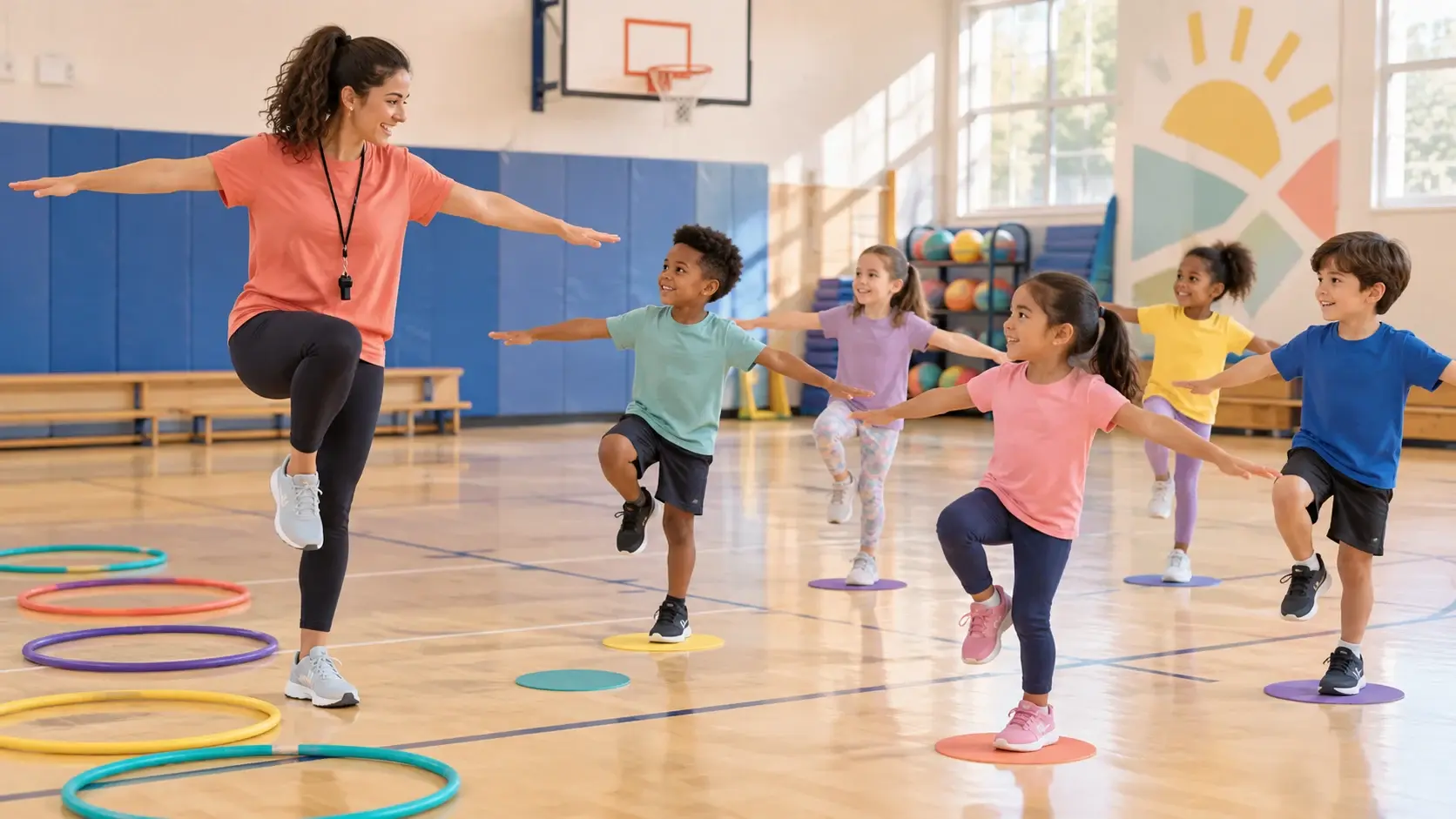
Main games (10–15 minutes)
These are the centerpiece of a PE class. Use a warm-up game first, play the main game, then cool down.
16. Capture the Flag
Grades 3–5 | 2 flags or pinnies, cones for boundaries | 5 minutes setup
Two teams, each with a flag placed in their territory. The goal is to grab the other team's flag and bring it back to your side without getting tagged. Tagged players go to a "jail" area and can be freed by a teammate's tag.
Rules:
- Divide the gym in half with a line of cones.
- Each team places their flag somewhere visible in their territory.
- Players cross into enemy territory to grab the flag.
- If tagged on the enemy side, go to the jail zone near the flag.
- A teammate can free a jailed player with a tag — both get a free walk back.
- First team to bring the enemy flag to their own side wins.
Variation: Multiple flags per team. You need all of them to win. This spreads out the action and prevents one fast kid from ending the game in 30 seconds.
17. Modified Kickball
Grades 2–5 | Kickball, bases or cones | 3 minutes setup
Standard kickball but with a rule change that keeps everyone moving: the entire fielding team must touch the ball before an out can be recorded. This means every kid is involved — no outfield daydreaming.
Rules:
- Set up a diamond with cones.
- Kicking team lines up. Fielding team spreads out.
- Pitcher rolls the ball. Kicker kicks and runs.
- Fielding team must pass the ball so every player touches it, then place it on the pitcher's cone.
- If the ball arrives at the cone before the runner reaches base, they are out.
- Three outs, then switch.
I found this variation solved the kickball problem that wears teachers down: the kid in right field who stands there for 20 minutes without touching the ball once.
18. Foam Dodgeball
Grades 3–5 | Foam balls (6–10) | 2 minutes setup
Use soft foam balls only. No headshots — any hit above the shoulders does not count and the thrower is out instead. Caught balls bring one eliminated teammate back in.
Rules:
- Two teams on opposite sides of the center line.
- 6–10 foam balls placed along the center.
- On "Go!" players grab balls and throw.
- Hit below the shoulders = you are out, sit on the side.
- Catch a thrown ball = thrower is out, one of your teammates comes back in.
- Headshot = thrower is out, target stays in.
- Round ends when one team is eliminated, or after 3 minutes (most players remaining wins).
Adaptation: "Doctor Dodgeball" — each team secretly picks a "doctor" who can bring eliminated players back in by touching them. If the doctor is hit, no more revives. Adds strategy.
19. Bowling Pins
Grades K–5 | 6–10 bowling pins per team, foam balls | 3 minutes setup
Each team sets up bowling pins on their side. Teams throw foam balls across the center line trying to knock down the other team's pins. Defenders can block balls but cannot touch the pins. First team to knock down all pins wins.
Rules:
- Two teams, each with a row of pins along their back wall.
- Foam balls placed at center.
- Throw to knock down enemy pins. Block incoming balls.
- No one may touch their own pins — if a pin falls from a block, it stays down.
- First team to topple all pins wins.
Indoor rainy-day games
The forecast says rain and your gym is being used for an assembly. These work in a classroom with desks pushed aside or a hallway.
20. Four Corners
Grades K–5 | Corner signs (1–4) | 1 minute setup
Number each corner 1 through 4. One student closes their eyes and counts to ten. Everyone else moves to a corner. The counter calls a number. Everyone in that corner sits down. Repeat until one player is left.
Rules:
- Label corners 1, 2, 3, 4.
- Counter closes eyes, counts to ten aloud.
- Players walk quietly to any corner.
- Counter calls a number. Those players are out.
- Last player standing is the next counter.
21. Heads Up, Seven Up
Grades K–5 | No equipment | 1 minute setup
Seven players stand at the front. Everyone else puts their head down with one thumb up. The seven each tap one person's thumb. "Heads up, seven up!" Players who were tapped guess who tapped them. If correct, they swap places.
It is gentle PE. On a rainy Tuesday, with a freshly waxed gym floor and 20 minutes to fill, that can be exactly right.
22. Yoga Freeze
Grades K–3 | Yoga pose cards (optional) | 1 minute setup
Play music. Students walk around the room. When the music stops, hold up a yoga pose card (or call one out). Everyone holds the pose for 10 seconds. Wobbles are fine. Falling over means you try a supported version.
Poses to use: tree, warrior, flamingo, chair, downward dog, mountain, star.
23. Paper Plate Skating
Grades K–5 | 2 paper plates per student | 1 minute setup
Each student stands on two paper plates on a smooth floor. They "skate" by sliding their feet. Set up a course with cones and challenge them to complete it without stepping off the plates.
Rules:
- One plate under each foot.
- Slide — do not lift and step.
- Navigate the cone course.
- If a plate tears, replace it.
This only works on hard floors. Carpet will stop the plates and the fun.
24. Balloon Volleyball
Grades 1–5 | Balloons, string or tape for a net | 3 minutes setup
Stretch a string across the middle of the room at shoulder height. Teams on each side volley a balloon back and forth. Standard volleyball rules but the balloon moves slowly enough that everyone can play.
Rules:
- String/tape net at shoulder height.
- Teams of 4–6 on each side.
- Balloon must be hit — not grabbed or held.
- Three hits per side before sending it over.
- If the balloon touches the floor, the other team scores.
- Play to 10 points.
Variation: Multiple balloons at once for large groups.
25. Fitness Bingo
Grades 2–5 | Bingo cards with exercises | 5 minutes prep
Create bingo cards where each square is an exercise: 10 jumping jacks, 5 push-ups, 15-second plank, 20 high knees. Call squares randomly. Students do the exercise, then mark the square. First to complete a row calls "Bingo!" and leads the class in one exercise of their choice.
How to split teams for any game
Fair teams make or break a PE class. Here is what works.
The 60-second method
- Open the Random Team Generator.
- Paste the class roster (or today's attendance list).
- Choose the number of teams.
- Shuffle. Copy the result to your clipboard or project it.
- Assign team colors or cones.
If students push for rerolls: "Two shuffles max, then we go." Set this rule on the first day and enforce it every day.
Counting off
No technology needed. "Count off by fours!" Students form teams by number. It is fast and random enough for daily use. Change the count each class so the same students are not always together.
Skill-balanced teams
For games where uneven skill makes the experience miserable (full-court basketball, for example):
- Mentally sort students into two tiers — more experienced and still learning.
- Shuffle each tier separately.
- Distribute one from each tier to each team.
You do not need to announce tiers. Just assign quietly.
Use the Random Name Picker when you need one student to demonstrate first or pick the game for the day. For regular classroom grouping beyond PE, the classroom grouping guide covers card methods, birthday lineups, and more.
Planning a PE class in 30 seconds
Pick one from each row:
| Slot | Time | Example |
|---|---|---|
| Warm-up | 3–5 min | Animal Walks or Simon Says Fitness |
| Main game | 10–15 min | Sharks and Minnows, Capture the Flag, or Modified Kickball |
| Cool-down | 3–5 min | Yoga Freeze or slow walking laps with deep breaths |
Rotate main games weekly. Warm-ups can repeat daily — students find comfort in the routine, and it means less time explaining rules.
Safety reminders that matter
- Check the floor. Wet spots from a leaky roof or a spilled water bottle cause falls. Walk the gym before students enter.
- Demonstrate before playing. "Does everyone understand?" gets nods. "Show me what you do when someone tags you" gets information.
- Foam balls only for throwing games. Rubber dodgeballs at a second-grader's face are a liability and a miserable experience.
- Hair and shoelaces. Untied shoes on a gym floor are a guaranteed fall. Check before the warm-up.
- Have an exit plan. If a game is not working, call it. "We're switching to Freeze Tag" is better than 10 minutes of chaos.
Where to find more games
The SHAPE America standards provide grade-level outcomes for physical education. PE Central has a free searchable database of lessons. WeAreTeachers' list of 76 elementary PE games is another solid starting point if you want even more options.
For splitting students into groups quickly, use the Random Team Generator. For picking individual students to lead or demonstrate, try the Random Name Picker. And for general classroom grouping beyond PE — card methods, colored sticks, birthday lineups — see the fun ways to divide students into groups guide.