
Fun Ways to Divide Students Into Groups Without Picking Captains
Nine classroom grouping methods, with worked headcounts, materials, planning times, and adjustments for students who need a different way to take part.

Here are nine fun ways to divide students into groups without picking captains. Each one comes with setup steps, materials, timing, class-size math, and accessibility notes, and each takes under two minutes to explain to a class.
I started collecting these my first year teaching, after a captain-picked draft left a quiet kid standing unchosen until I "assigned" him. He cried at break. I never picked captains again, and eight years of classrooms later, this is the playbook.
Featured tool
Random Team Generator
Enter the class list, choose a group count, and shuffle. Check the result before students move. Use only the identifying information your school allows.
Choose a method for the room you've got
| Method | Preparation to allow | In-class time to allow | Example |
|---|---|---|---|
| Playing cards | About 5 minutes for a prepared deck | 1–2 minutes | 28 students, seven groups of four |
| Colored sticks | About 10 minutes to mark a set | 1–2 minutes | 24 students, six groups of four |
| Birthday lineup | None | 3–5 minutes | 30 students, five groups of six |
| Number-off | None | 1–2 minutes | 27 students, seven groups |
| Picture pieces | 15–20 minutes for a reusable set | 2–4 minutes | 24 students, six groups |
| Partner cards | About 10 minutes for a set | 1–3 minutes | 26 students, thirteen pairs |
| Clock buddies | A clock sheet for each student | About 15 minutes initially | Reusable pairs, with an absence plan |
| Four Corners | Four signs | 2–5 minutes | Four starting locations |
| Digital shuffle | A checked name list | About a minute, plus moving | 31 students, six groups |
Treat those times as planning estimates. Walking to tables can take longer than dealing the cards.
For PE, use the gym-class grouping guide, which covers skill balance. Picking an individual to speak is a separate job; the classroom name-picker guide covers that.
1. Playing cards
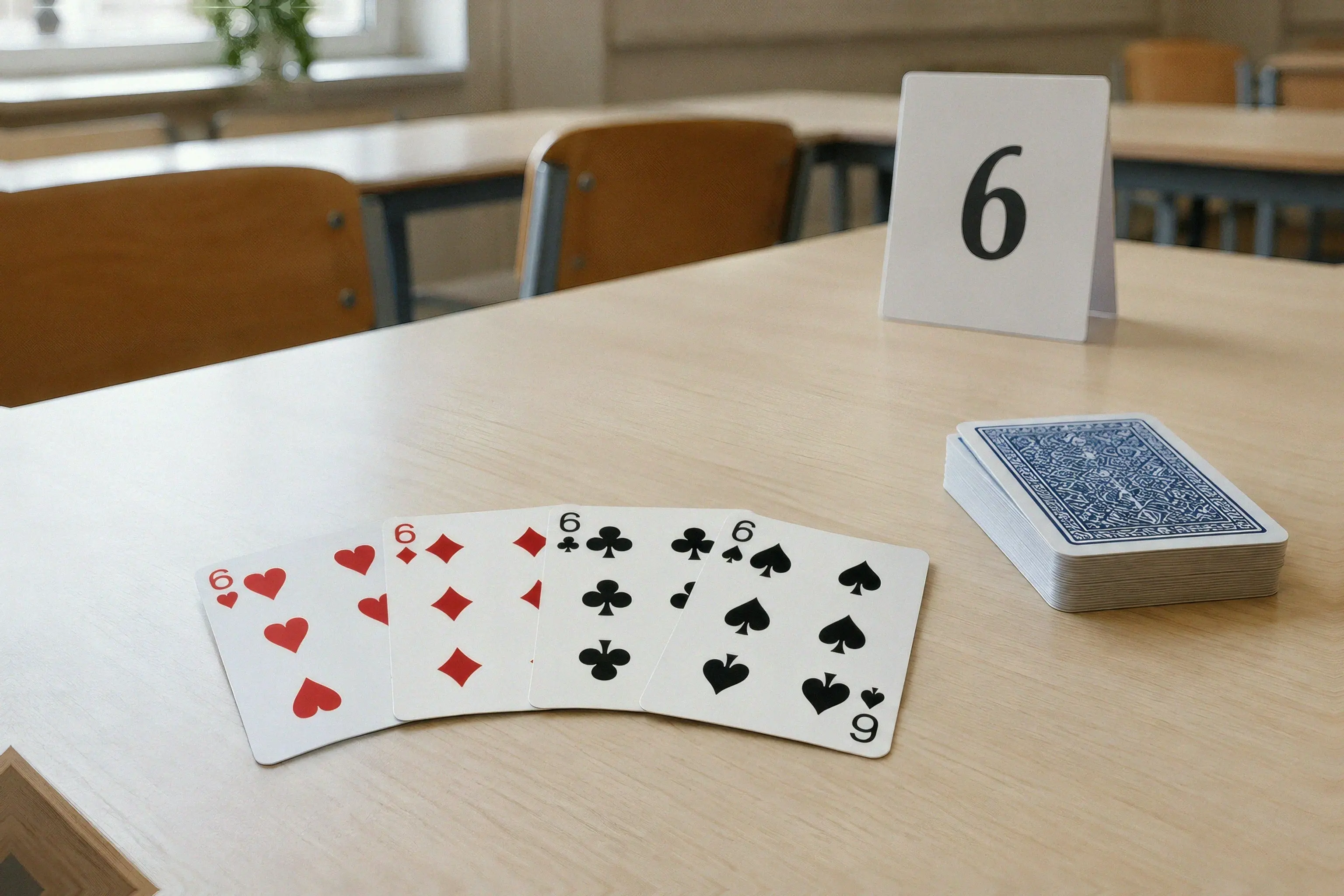
Prepare the deck before class. For 28 students in groups of four, take all four suits of each rank from ace through seven. Shuffle those 28 cards.
Deal one to each student. Put a large matching rank on each table so students have somewhere definite to go. A student holding the six of hearts joins the other sixes, regardless of suit.
There's a useful second arrangement hiding in the same deck. Grouping by suit gives four teams of seven. Grouping by red or black gives two teams of fourteen. Announce which feature matters before anyone moves.
Use large-index cards when the tiny corner numbers are hard to read. Explain the ace, too; familiarity with card symbols varies. If moving tables is difficult for a student, bring the group to their table and distribute the remaining places around that arrangement.
I would use cards for an ordinary review activity. They take little explaining once students know the routine.
2. Colored sticks
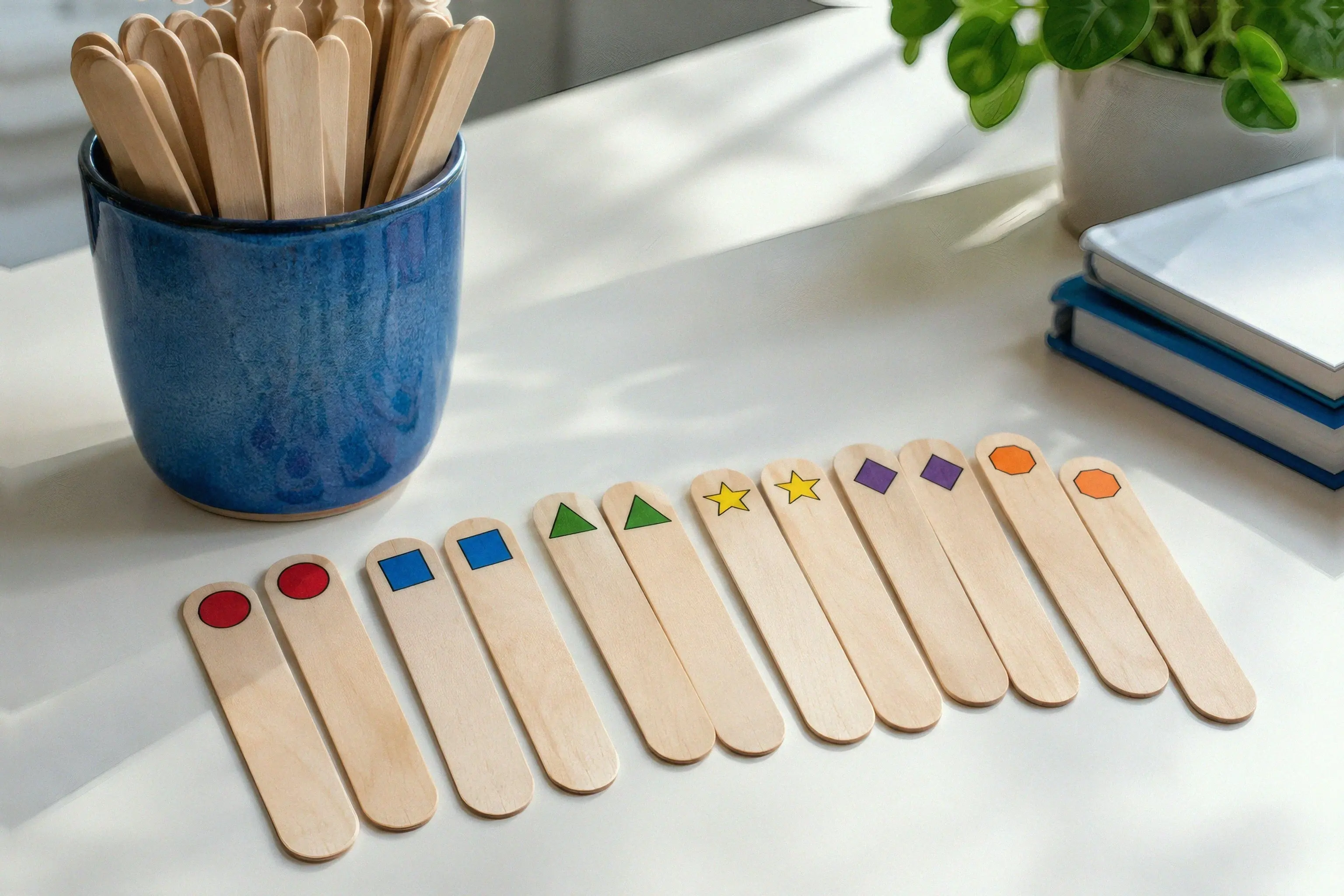
For six groups of four, prepare 24 blank craft sticks. Mark four sticks with each of six colors. Add a number or shape beside every color, then hide the marked ends in a cup.
Students draw one stick and go to its matching table. You could use colored paper slips instead if there are no sticks in the supply cupboard.
Leave names off this version. A name permanently paired with a color creates a fixed assignment. If you already have named sticks, draw names at random and deal them into groups in sequence rather than treating the old colors as a fresh shuffle.
Post both the number and the color at the tables. A pale yellow dot on unfinished wood can be hard to see even up close (the darker marker earns its place here). With 24 students, four colors would make four groups of six; six colors make the six groups of four in this example.
3. Birthday-month lineup
Ask students to arrange themselves from January through December. You can allow conversation or make it a gesture-based challenge, depending on who can participate comfortably.
Avoid making someone disclose a birthday if they would rather not. An assigned month card gives them a place in the activity. Students who need to remain seated can direct the order using cards on a table.
Once the line is ready, split it into consecutive groups of six for a class of 30. That gives five groups. Alternatively, count off one through five repeatedly and send matching numbers together.
Counting to six would give you six groups of five. A small difference in the instruction, quite a different room.
Birthday lineups also appear in Oxford University Press's grouping activities. The lineup is ordered by birthdays, so avoid describing its outcome as a fresh random shuffle. Repeating it can put the same students together.
4. Count off with words
Use familiar words in place of numbers. For seven groups, you could cycle through seven breakfast foods. Write the words on the board, with a table number beside each.
For 27 students, repeat the seven-word sequence until everyone has one. Six groups receive four students and the seventh receives three. Check who has the final word before sending the class across the room.
Changing "one" to "pancake" doesn't stop students from predicting the sequence. If they keep moving to match a friend, deal shuffled word cards instead. You can keep the same table signs.
No materials are needed for the spoken version. For students who may miss an instruction, provide the word in writing or with a picture. Avoid depending on everyone remembering a long verbal sequence.
5. Match picture pieces
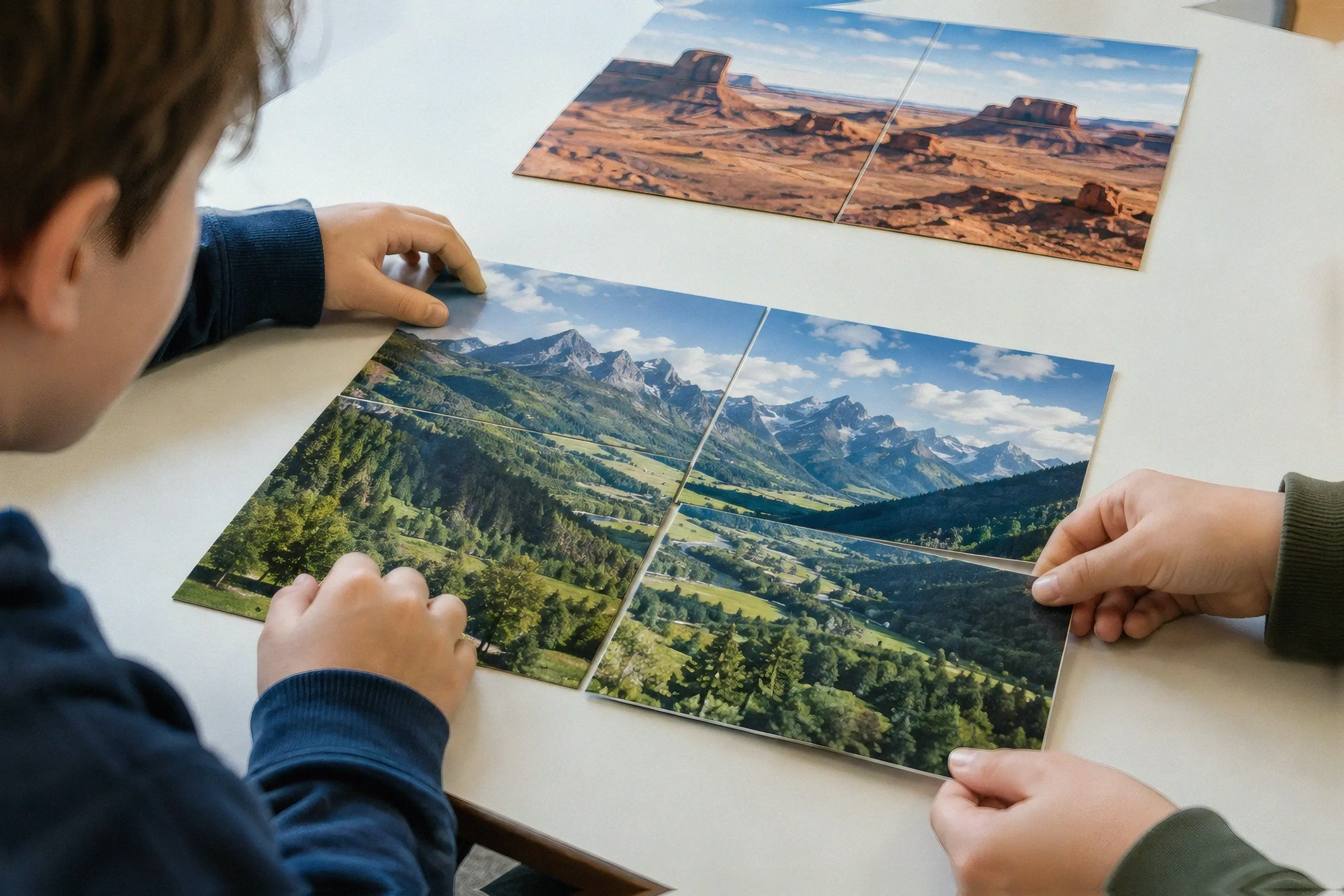
Choose six distinct images for 24 students. Cut each into four pieces, mix them, and hand out one piece per student. Completed pictures form the groups.
Make the pictures easy to tell apart. Six nearly identical blue seascapes might turn a two-minute transition into an unscheduled puzzle lesson. Six different landforms would let each group use its picture as the topic for the work that follows.
Keep a complete copy of each image at the relevant table. Use large, high-contrast pieces, and offer labels or a different matching method for students who need them. A visual puzzle is not automatically accessible to everyone.
Put the sets in separate envelopes afterward. Count the pieces before the next class. With 23 students, one picture can use three pieces while the others use four; prepare it that way rather than leaving someone to hunt for an absent fourth piece.
6. Partner cards
Write matching pairs on index cards. A lock matches a key. Thunder can match lightning. Choose combinations the class recognizes, and add pictures where useful.
Thirteen matching sets give 26 students a partner each. For 27, make twelve pairs and one trio, perhaps bread with peanut butter and jelly. Explain which cards belong to the trio before the search starts.
The search can happen from seats if movement or noise is a problem. Have students hold up cards while you help locate matches.
- Check the vocabulary. A food pairing familiar in one household may be unfamiliar in another.
- Keep a spare card set.
- When two students need to work apart, assign their cards deliberately. You can say that some partners are teacher-arranged without announcing why.
7. Clock buddies
Give each student a clock sheet with spaces beside 12, 3, 6, and 9. At each time, students need a partner who writes their name in the same slot.
Check reciprocity. If Ana has Luis at three o'clock, Luis must have Ana there too. A mismatched appointment becomes obvious only when you ask them to meet.
You can assign appointments or let students arrange some of them, while helping anyone without a match. Student-selected appointments can reproduce friendship groups. Four empty lines on a worksheet don't prevent that.
With 29 students, each time slot needs thirteen pairs and one planned trio. Mark the trio clearly on all three sheets. Also decide what happens when a partner is absent; a nearby pair may become a trio for that activity.
Once the sheets are correct, you can call a time and reuse the pairs. Do not combine two appointment times and assume you'll get groups of four. Overlapping partnerships can link much larger chains of students.
8. Four Corners
Put a sign in each corner, or use four accessible locations around the room. Students can choose a position on a statement such as "Homework should be optional," provided that topic suits the lesson.
The corners may be very uneven. If seventeen students agree, that corner needs smaller discussion groups before everyone can contribute. Count off within the crowded corner or divide the students into nearby groups.
For four randomly assigned starting groups, shuffle numbered cards instead. Letting students choose any corner is self-selection.
Keep clear routes between the locations. A student can indicate a choice from their seat and have the discussion group join them. Read the statement aloud and display it so people can refer back to the wording.
9. A projected shuffle
Open the Random Team Generator, enter the students present, and choose the number of groups. Use a projector if you want the class to see the result, or read out groups and provide another accessible copy.
For 31 students split six ways, the sizes are 6, 5, 5, 5, 5, and 5. Check the names before moving on; a duplicated name can be harder to spot than a lopsided group.
The result still needs your judgment. A reroll might separate two students, but it doesn't guarantee that they stay apart. If separation is required, assign or adjust their groups directly. Explain before shuffling that you may make changes for the activity without sharing private student information.
The Random Pair Generator is another option for partner work. Use a Random Name Picker when you only need someone to present first.
When you should arrange the groups
A reading activity may call for a particular kind of support. A project may need each group to have someone comfortable with the recording equipment. Plan those groups around the task.
Known conflicts matter too. You don't need to stage a supposedly random draw and secretly rearrange cards. Tell the class that you are assigning some places and leave the reasons private.
Random grouping avoids a public sequence of choosing classmates. It can't promise that nobody feels excluded or that every group will work well. Watch what happens after the shuffle.
Regrouping and missing students
You can change groups between unrelated activities. For a project that lasts two weeks, keeping the group together may be useful; review it sooner if something is going wrong.
- One absence. See whether the remaining group can do the task. Moving an entire group may create more disruption than redistributing one role.
- A new student needs a place and someone to explain the activity. Add them where there's room and make the introduction.
- Lost cards happen. Ask what happened before assuming a student traded theirs.
- Keep a record of the current groups when work spans several lessons. A photo of table labels alone won't tell you where the absent student belongs tomorrow.
Questions that come up during the shuffle
What if students want their friends?
Explain how today's groups were chosen and how long the activity lasts. Hear a request privately when there's more behind it than a preference. You can allow student choice for another task without promising it every time.
How big should groups be?
Pairs suit a quick discussion. Start with three or four for shared work, then check whether the activity gives everyone something to do. Six students around one worksheet may leave several waiting for the pencil.
Does an odd number of teams prevent ties?
No. Scores can tie with any number of teams. Plan a tiebreaker if the game needs a winner, such as one additional question with the same answering conditions for every tied team.
What if 27 won't divide into fours?
Seven groups gives six groups of four and one of three. Six groups gives three groups of five and three groups of four. Choose whichever arrangement fits the task and available tables.
The Random Order Generator can set the presentation sequence once those groups are settled.
Related Articles
Published
List of Pictionary Words (Easy, Hard, Funny, and Classroom-Friendly)
500+ Pictionary words organized by difficulty and theme. Easy, medium, hard, funny, kid-safe, adult, holiday, and classroom lists, plus a free generator for live play.
Published · Updated
Random Name Picker for the Classroom (Fair Calls, Less Stress)
A simple routine for fair participation, plus classroom-ready use cases and kind rules that keep it low-pressure.
Published · Updated
Elementary PE Games With Simple Rules and Fair Teams
A ready-to-use PE games collection with rules, equipment, grade ranges, and team-splitting tips for every game. Includes tag, relay, cooperative, warm-up, and indoor rainy-day options.